Research · Multi-agent systems · 2026
Stigmergic Graph Memory
A first-author paper (submitted to a major ML/AI conference and currently in phase 2 reviews) that treats endpoint selection in many-to-many warehouse pickup and delivery as a congestion-control decision: a bounded, decaying graph-memory layer reads recent execution history to steer which source–destination pairs enter the planner, before any path is fixed.
Problem
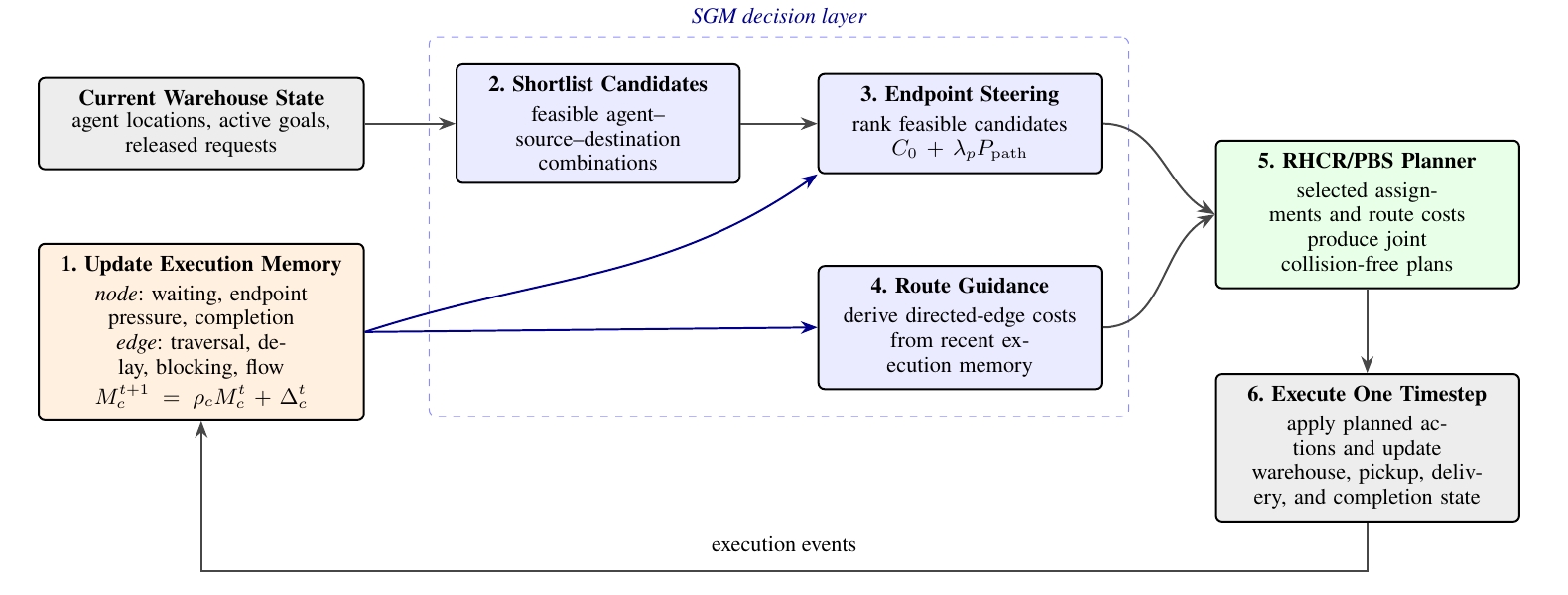
In many-to-many pickup and delivery, a warehouse request names a stock-keeping unit, not a fixed pickup and drop-off. The controller has to choose an agent, a source, and a destination before any path is planned. Existing graph-guidance methods only shape routing after those goals are fixed, so endpoint selection stays blind to recent traffic — and individually cheap source–destination pairs keep piling work onto the same corridors and stations.
Approach
SGM is a bounded, decaying memory layer over the warehouse graph, inspired by stigmergy: the indirect, trace-based coordination behind ant-colony optimization. It records recent execution signals on nodes (waiting, endpoint pressure, completions) and on directed edges (traversal, delay, blocking, flow), then uses them to rank which feasible source–destination pairs enter the planner and to bias route costs. It sits on top of an RHCR/PBS planner and only re-scores feasible candidates and legal moves, so a feasibility proof guarantees every executed plan stays collision-free and task-feasible.
Outcome
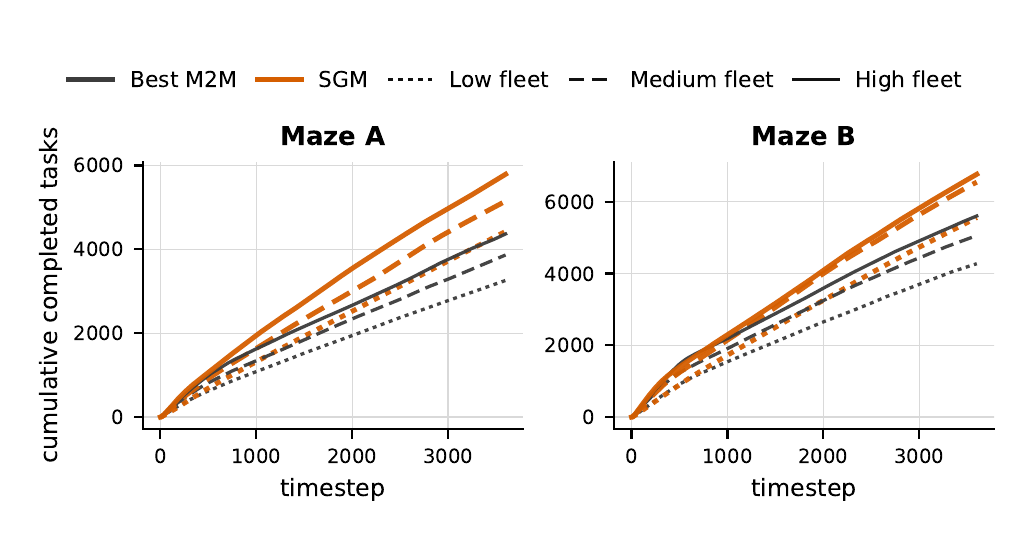
Across paired request streams on five layouts, three fleet sizes, and 25 seeds, SGM beats two reconstructed many-to-many baselines in all 15 map–fleet conditions, with throughput gains of 20.5–36.7%. Component ablations pin the gain on endpoint steering — deciding which work enters the planner — while route guidance further trims planner time, waiting, and blocked moves. The paper is first-authored with Joon-Seok Kim and is submitted to a major ML/AI conference and currently in phase 2 reviews. I won the UPenn NRC Lucid Challenge with this paper and presentation.